
AI search optimization – also called GEO (generative engine optimization) or AEO (answer engine optimization) – is the practice of structuring your content, entity data, and off-site reputation so AI assistants cite and recommend your business when someone asks a question you should be the answer to. For Dallas businesses in 2026 it rests on five things: an answer-first content structure, complete structured data, a consistent entity presence across the web, third-party mentions on sites AI systems trust, and a genuinely strong Google Business Profile – because local AI answers lean heavily on it.
What actually changed
A Dallas homeowner used to search “best foundation repair Dallas,” scan ten blue links, and open three. In 2026, a growing share of them open ChatGPT or Gemini and ask “who should I call for foundation repair in Lakewood, and what should it cost?” and get one answer naming two or three companies.
The numbers behind that shift are no longer speculative. AI Overviews appear on a substantial share of Google queries and reach close to a billion searchers. ChatGPT serves hundreds of millions of weekly users, and its citations now drive measurable referral traffic to tens of thousands of domains. Zero-click searches on Google rose sharply – from roughly 56% to 69% in the twelve months after AI Overviews launched, per Similarweb.
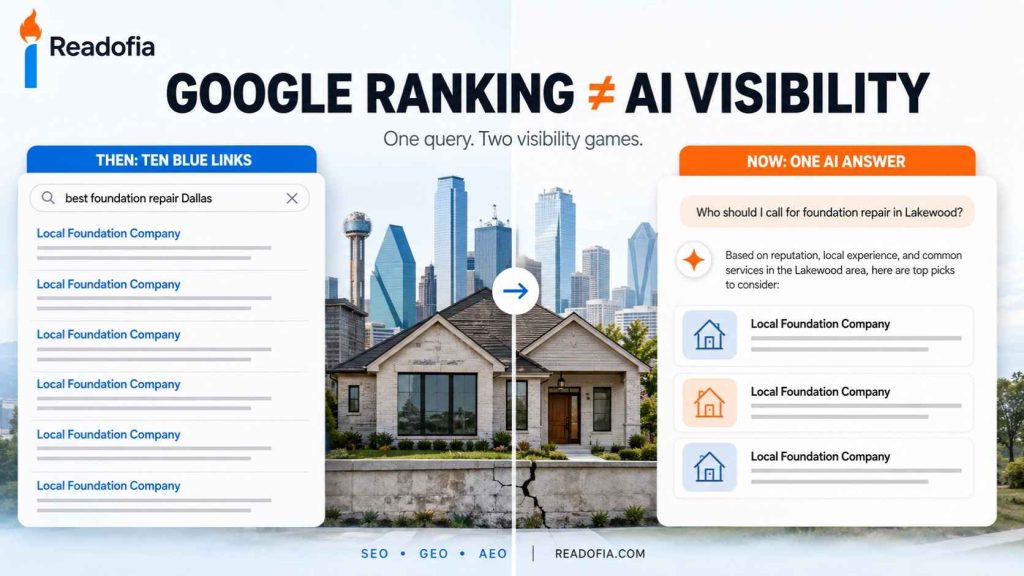
The part that should get your attention: ranking #1 on Google no longer guarantees you appear in the AI answer. Research from the GEO firm Brandlight suggests the overlap between the top Google links and the sources AI systems cite has fallen from around 70% to under 20%. These are becoming two different visibility games, and most Dallas businesses are only playing one.
Why this matters more for local businesses, not less
There’s a common assumption that AI search is a B2B and SaaS problem. It’s backwards for a market like DFW.
- Local queries are conversational by nature. “Who’s the best pediatric dentist near Preston Hollow that takes my insurance?” is exactly the kind of multi-constraint question people bring to an assistant instead of a search box.
- AI answers pre-qualify. A user who arrives from an AI citation has already been given a recommendation. Conversion rates from these referrals run notably higher than generic organic.
- The field is empty. In competitive Dallas verticals, the fight for Google position #1 has been going on for fifteen years. The fight for the AI answer started eighteen months ago. There is still a first-mover position available in most DFW categories and it will not be available in 2028.
- AI citations arrive faster. Practitioners report first citations within roughly 4–10 weeks of proper optimization, against 3–6 months for meaningful traditional SEO movement.
The Dallas AI search playbook
1. Restructure content to be extractable
AI systems lift passages. Write so passages can be lifted cleanly.
- Lead with the answer. Put a direct 40–60 word answer immediately under each H2, then explain. The pattern in this article is the pattern.
- Use question-shaped headings that match how people actually ask: “How much does foundation repair cost in Dallas?” not “Our Pricing.”
- Be specific and numeric. “$4,500–$12,000 for pier and beam repair in DFW clay soil” gets cited. “Affordable rates” never does.
- Date your content and update it. Freshness is a strong citation signal; a visible “Updated August 2026” line helps.
- Keep paragraphs short and self-contained. A paragraph that needs the previous three to make sense won’t survive extraction.
- Add FAQ blocks to every service and location page.
2. Get your structured data right
Schema is how you tell machines what you are rather than hoping they infer it.
LocalBusiness(or the specific subtype) withareaServed,geo,priceRange,openingHoursSpecificationFAQPageon service and location pagesServicewith explicitareaServedfor each DFW cityOrganizationwithsameAslinking every profile you own – GBP, LinkedIn, Facebook, Yelp, industry directoriesPersonschema for owners and key staff, connected to their credentials and bios
The sameAs work matters more than it looks. It’s how you consolidate scattered mentions into one recognizable entity.
3. Build entity consistency
AI systems assemble a picture of your business from everything they’ve read. Contradictions dilute confidence.
Your business name, address, phone, services, and service area should be identical everywhere: your site, GBP, Apple Maps, Bing Places, LinkedIn, Yelp, chamber listings, industry directories. Same owner bio. Same founding year. Same description language. For DFW businesses that have moved offices, changed suite numbers, or rebranded – which is most of them, in a metro growing this fast – this is usually where the cleanup is.
4. Earn third-party mentions
This is the highest-leverage and hardest item on the list. Ahrefs’ 2026 analysis found external brand mentions were among the strongest correlates with appearing in AI Overviews (a correlation of roughly 0.66). AI systems also draw disproportionately from news and media sources.
Practically, for a Dallas business:
- Local and regional press – Dallas Morning News, D Magazine, Dallas Business Journal, Dallas Innovates, Culture Map, community outlets in Plano, Frisco, and Arlington.
- Industry publications in your vertical.
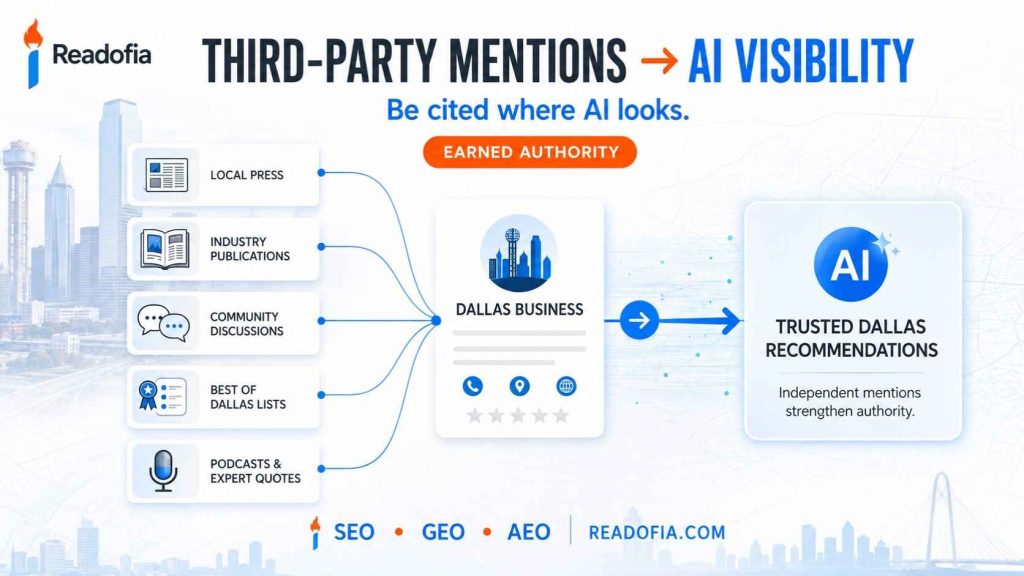
- Reddit, Quora, and forums. AI systems weight community consensus heavily. Being genuinely mentioned in r/Dallas threads about your service category is worth more than most link building. Participate honestly; astroturfing is both detectable and reputationally expensive in a market where people talk.
- “Best of Dallas” listicles. When someone asks an AI for the best X in Dallas, it frequently synthesizes from these roundups. Getting included in them is direct AI-visibility work.
- Podcasts, local panels, and expert quotes. Being the named source in someone else’s content is exactly what AI systems reward.
5. Don’t neglect the Google Business Profile
Google’s own 2026 guidance is explicit that foundational SEO still matters, because AI Overviews and AI Mode draw on Search’s existing ranking and quality systems. For local queries specifically, AI answers lean heavily on Google Business Profile data and review content.
Which means the work in our Dallas local SEO checklist is not separate from AI optimization. It’s the foundation of it. Your review text in particular gets read and summarized by AI systems – reviews that name the specific service and neighborhood feed the answer directly.
6. Make sure the crawlers can reach you
Check your robots.txt and firewall rules. GPTBot, OAI-SearchBot, PerplexityBot, ClaudeBot, and Google-Extended are separate user agents from Googlebot, and plenty of sites are unintentionally blocking them – often through a WAF rule nobody remembers adding. Blocked crawler, no citation. This is a ten-minute check that occasionally solves the entire problem.
How to measure AI visibility
Traditional rank tracking doesn’t capture any of this. Set up the following instead:
- Prompt tracking. Build a list of 30–50 questions a real Dallas customer would ask – “best HVAC company in Frisco,” “how much does a roof replacement cost in Dallas,” “emergency plumber near Deep Ellum.” Run them monthly across ChatGPT, Gemini, Perplexity, and Google AI Mode. Log whether you appear, who else does, and what’s cited.
- AI referral traffic in GA4. Segment referrals from chatgpt.com, perplexity.ai, gemini.google.com, and copilot.microsoft.com. Small volume, high intent – watch conversion rate, not sessions.
- Brand mention monitoring. Track unlinked mentions across the web, not just backlinks. Mentions are the currency here.
- Share of voice by prompt category. For your ten most commercially valuable questions, what percentage of AI responses include you?
The industry is shifting from keyword volume toward “prompt volume” as the demand signal. Start building that list now; it becomes your content roadmap.
What to be skeptical about
The GEO space is full of tools promising to “guarantee AI citations.” Nobody can. Platform behavior changes fast, source selection varies by topic, and visibility measured from a single prompt on a single assistant is noise. Anyone selling certainty is selling something else.
The durable version of this work is unglamorous: be genuinely good at what you do, document it clearly and specifically, get named by credible third parties, and keep your data consistent. That has always been what search rewarded. AI just made it harder to fake.
Frequently asked questions
What is GEO / AI search optimization?
Structuring your content, structured data, and off-site presence so AI assistants like ChatGPT, Gemini, Perplexity, and Google AI Overviews cite or recommend your business in their generated answers.
Is AI search optimization replacing SEO?
No – it sits alongside it. Google’s own 2026 guidance confirms AI features draw on existing Search ranking systems, so crawlable, fast, authoritative pages remain the foundation.
How long until my Dallas business gets cited by AI?
With schema, answer-first structure, and E-E-A-T signals in place, practitioners commonly see first citations in 4–10 weeks – faster than traditional SEO, though holding the position takes ongoing work.
Does this cost extra on top of SEO?
Some agencies bundle it; others price it at $500–$2,500/month additional. See our Dallas SEO cost guide for how to read a proposal.