
If you own a tire or wheel shop and you have been quoted a Google Ads budget by an agency, you have probably had the same reaction most owners have. The number sounds arbitrary. Nobody explains where it comes from. And when you ask what you will get back, the answer turns vague.
Here is the honest version, written for shop owners rather than marketers.
The short answer
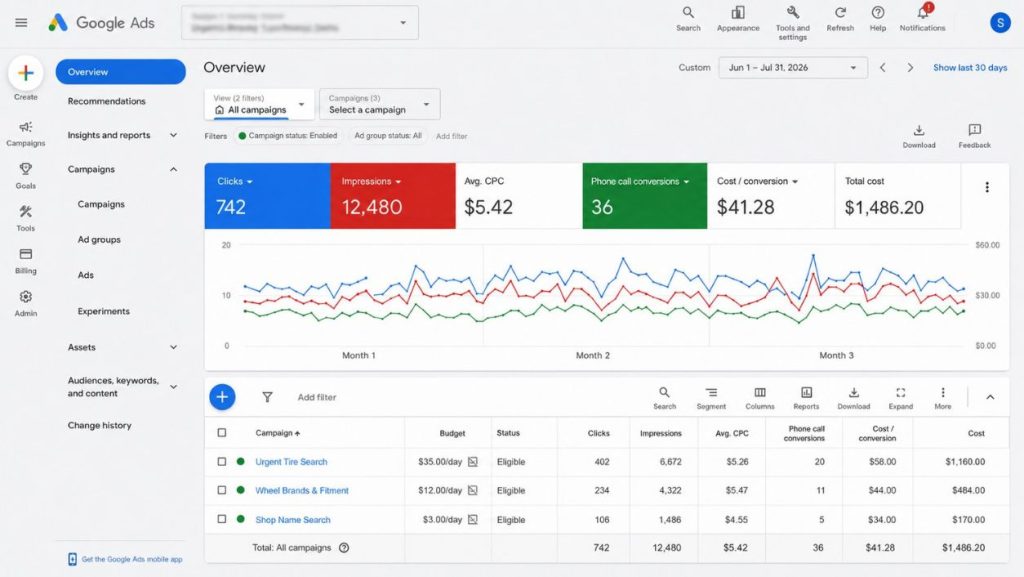
- Most independent tire and wheel shops should start somewhere between $1,000 and $2,500 a month in ad spend, not counting management fees. That works out to roughly $35 to $80 a day.
- But that range is close to useless on its own, because the right number for your shop depends on three things: how many customers you can physically handle, what a customer is worth to you, and how much competition you have inside a ten mile radius. Work through those three and you will land on a number you can actually defend.
Why the floor is around $30 a day
- Below about $20 to $30 a day, Google Ads tends not to work. This is not a rule Google publishes, but it holds up across small local accounts consistently.
- The reason is data. Google’s system needs a certain volume of clicks and conversions before it can tell which searches are worth showing you for and which are wasting money. At $10 a day in a competitive market, you might get three or four clicks. Some days you will get one. The account never gathers enough information to improve, so it stays expensive and unfocused, and after two months you conclude that Google Ads does not work for tire shops.
- It does work. It just does not work at a budget that starves it.
- If $30 a day is genuinely out of reach right now, you are better off putting that money into your Google Business Profile and Facebook Marketplace, both of which cost nothing but time. Come back to paid search when you can commit properly.
What a click actually costs you
- In the tire and wheel space, cost per click varies enormously depending on what someone is searching for.
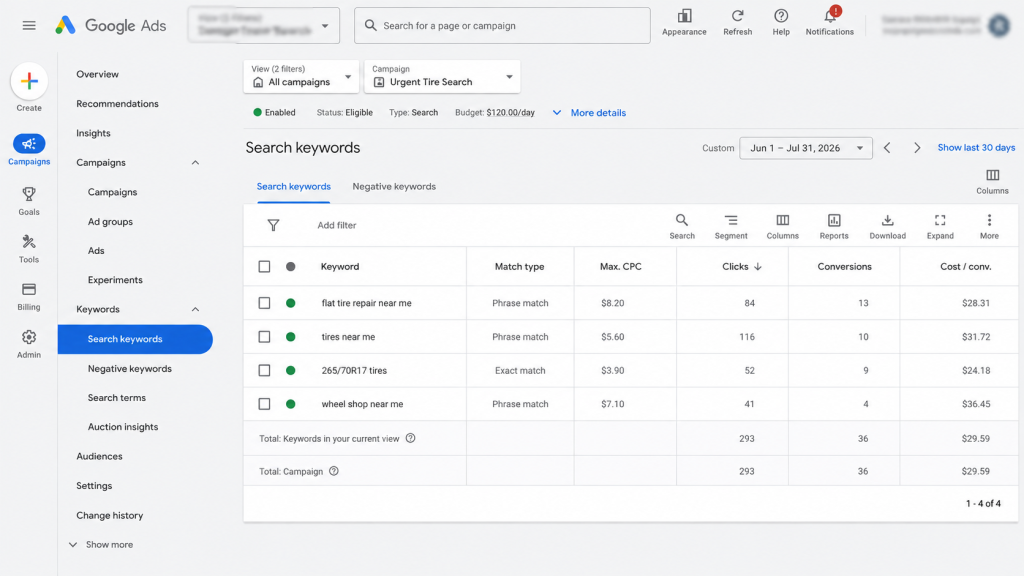
- Urgent repair searches like “flat tire repair near me” tend to be among the more expensive clicks in local automotive, often somewhere in the $4 to $12 range depending on your city. Every shop in the area wants that customer, and they want them right now.
- General searches like “tires near me” sit lower, but they also convert less predictably, because the person might be price shopping, might be twenty miles away, might be looking for a chain.
- Size specific searches are the interesting ones. Somebody typing “265/70R17 tires” knows exactly what they need. Those clicks are frequently cheaper than the generic terms, because most shops never think to bid on them, and they convert better because the searcher is past the browsing stage. If you sell it, they want it.
- Wheel searches behave differently again. Brand terms like Fuel, Method, XD or Rotiform attract a buyer with a much higher ticket, often several times a tire sale, and a longer decision window. You pay more per click and you wait longer for the sale, but the sale is worth more when it lands.
Working out your own number
- Start with what a customer is worth. Not the ticket on one visit. What a customer is worth over the two or three years they keep coming back. A tire customer who returns for rotations, an alignment, and a second set eventually is worth considerably more than the first invoice suggests. Wheel customers often bring a friend, because wheels get noticed in a way that tires never do.
- Then decide what you can afford to pay for one. If a new customer is worth $600 to you over time and your margin is reasonable, paying $40 or $50 to acquire one is a good trade. Most owners instinctively compare ad cost to the first sale only, which makes every marketing channel look worse than it is.
- Then work backwards. If you want ten new customers a month from Google, and you can close roughly a third of the leads that come in, you need about thirty leads. If leads cost you $25 to $40 each, you are looking at $750 to $1,200 a month in spend.
That is your number. It came from your business, not from a template.
What to expect in the first ninety days
This is the part agencies skip, and it causes more cancelled contracts than anything else.
- Month one is expensive and it is supposed to be. The account is learning. You are paying for clicks that turn out to be worthless so the system can find out they are worthless. Your cost per lead in month one is not your cost per lead. Anyone who shows you month one numbers as a verdict is either inexperienced or hoping you are.
- Month two is where it should start tightening. Negative keywords have been added, the searches that never convert have been blocked, ad copy has been tested. Cost per lead typically drops noticeably.
- Month three is your real baseline. By now the account has enough conversion history for automated bidding to work properly and for you to judge honestly whether the channel pays.
If you are not seeing meaningful improvement from month one to month three, that is a genuine signal, and it is worth asking hard questions.
Where tire shop budgets get wasted
A few things burn money in almost every account I have looked at.
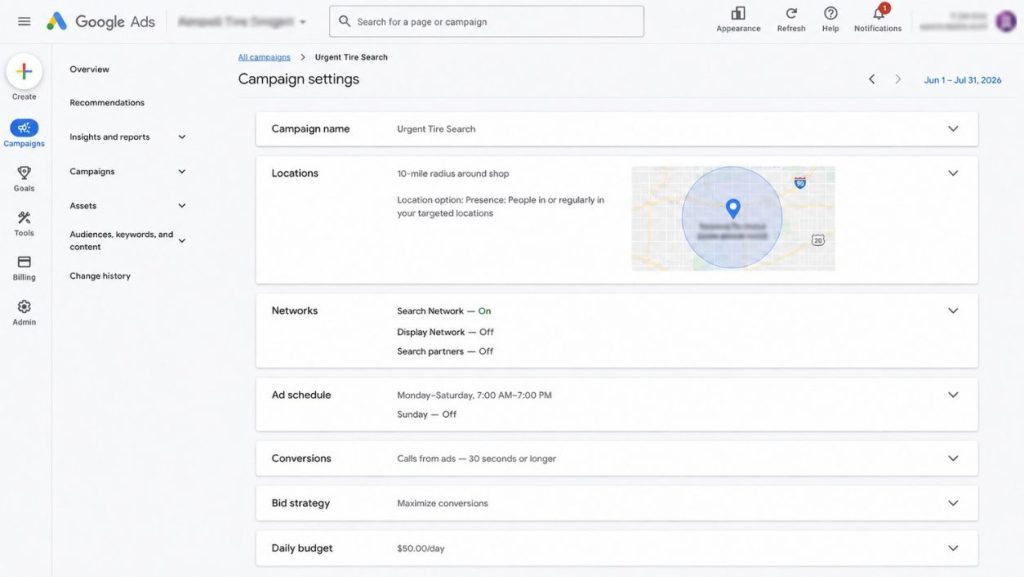
- The Display Network being left on. When you create a search campaign, Google helpfully offers to include display and search partners. Those placements will eat a large share of your budget showing your ad on random apps and websites to people who were not looking for tires. Turn it off.
- No negative keywords. Without them you will pay for “used tires,” “free tire disposal,” “how to change a tire,” “tire recycling,” and every job listing search in your city. A proper negative list for a tire shop runs to a few hundred terms and it is the single highest return hour anyone can spend in your account.
- Targeting set too wide. Most shops draw customers from five to ten miles. Wheel shops with financing can pull further, sometimes twenty five or thirty. Beyond that you are paying to reach people who will drive to somebody closer. Also check the setting for whether you are targeting people in your area or people interested in your area, because the second one is the default in some setups and it means you are paying for clicks from other states.
- Running ads when you are closed. If nobody answers the phone at 9pm, do not pay for a click at 9pm. Schedule to your opening hours plus an hour before you open, since people search on the way to work.
- Sending everyone to the homepage. A person searching for a specific wheel brand should land on a page about that brand. A person searching for flat repair should land somewhere that says you fix flats today and gives them a phone number above the fold.
The thing that matters more than the budget
- You can get every setting right and still lose money, if the phone is not answered.
- Tire and wheel buying is unusually time sensitive. Somebody with a flat is calling three shops and going with whoever picks up. Somebody pricing wheels is messaging four places and buying from whoever responds first with a real answer.
- Before you increase your ad spend, find out how many of your calls go unanswered during business hours. Most shops are surprised, and the number is usually worst at exactly the times you are busiest, which is also when the ads are working hardest.
- Fixing that costs nothing and improves your return more than doubling your budget would.
Should you run Google Ads at all?
Not every shop should, at least not first.
- If your Google Business Profile is incomplete, has few reviews, or does not show up when you search your own service in your own town, fix that before you spend anything on ads. The profile drives free calls and direction requests, and paid ads pointing at a weak profile convert worse.
- If you have never listed wheels on Facebook Marketplace, do that first too. It costs nothing, and for wheel sales specifically it often outperforms paid channels on cost per lead by a wide margin.
- Google Ads is the right investment once the free foundations are in place and you want volume you can control and scale. It is the wrong first investment for a shop with no reviews and no online presence, because you are paying to send people to something that does not convince them.
A realistic starting structure
If you are ready, a workable first build looks like this.
- Split the money across three campaigns. Put most of it behind urgent tire searches, since those close fastest. Put a smaller amount behind wheel searches by brand and vehicle type, accepting a longer sales cycle. Keep a very small budget on your own shop name, which is cheap and stops competitors appearing above you when someone searches for you directly.
- Track phone calls over thirty seconds as your main conversion, not clicks and not form fills alone. Most of your business arrives by phone and if you are not measuring calls you are measuring the wrong thing.
Review it weekly for the first month, then monthly. Judge it at ninety days.
The summary
Start at $30 to $50 a day if you are a single location shop. Expect month one to look bad and month three to tell the truth. Calculate what a customer is genuinely worth to you before you decide what you can afford to spend. And answer the phone.
Readofia works with independent tire and wheel shops on local search, paid ads and Facebook Marketplace. If you want a straight assessment of where your shop currently stands online, we will look at your Google Business Profile, your rankings and your competitors and tell you what we find, at no cost.